Tuesday, 19 February 2013

The Song of Achilles, by Madeline Miller

I first heard of The Song of Achilles when Madeline Miller won last year’s Orange Prize, an impressive achievement for a debut novel. Miller teaches Latin and Ancient Greek, so has a strong background to take on Homer. As a long time classics geek myself, I put it on my to-read list. Her take on Achilles is undeniably modern, and manages to strike a difficult balance by giving justice to the complex world of classical myth while being readable to a layperson.

The Song of Achilles takes its title from the opening line of The Iliad
Sing, goddess, the anger of Peleus’ son Achilleus
but is not solely about the events that take place in the epic poem, which rather than telling the story of the fall of Troy as is often assumed, actually only relates the events of a few weeks in the tenth year of the war. Miller takes much of her story from events related in the Epic Cycle, and throws in a fair bit of her own invention. Her version of this ancient myth is narrated by Patroclus, Achilles’s closest friend, and, as Miller interprets, lover. Her story begins with Patroclus’s childhood, when he is exiled by his family and sent to live in the court of Peleus. Here, he and Achilles strike up a boyish friendship that over the years grows into a romantic relationship. These events take up almost the whole first half of the novel. We are introduced to a very different Achilles from the wrathful one I knew from the classics. Here he is a laughing, energetic boy, albeit a rather gifted one (his mother is a goddess after all). Our view of him is through the prism of Patroclus’s feelings, yet we see glimpses at times of insouciance that could so easily be arrogance, determination that could become stubborn pride. The love story is handled with a light touch, and beautifully told, yet I found myself wanting things to move forward a little quicker.

At last our heroes reach the shores of Troy, and the story spins through to its inevitable conclusion - the story of The Iliad: Agamemnon (the most powerful Greek king) and Achilles will fight; whilst Achilles sulks, Patroclus will fight in battle and be killed by Hector; Achilles will then kill Hector in a rage. Spoilers? No, the Iliad is thousands of years old. This of course poses the problem of how to keep it interesting when we already know what will happen. Wisely, I think, Miller doesn’t try to make the ending a surprise. By using the classical beliefs in prophecy and the fates, our heroes themselves are aware that Achilles will kill Hector, and in doing so will cement his reputation as ‘Aristos Achaion’ the best of the Greeks, but this will also lead to his own death.

The second half of the novel is what I had hoped for when I started. At first Patroclus admires Achilles, seeing him in a new light as he triumphs in battle
I could not see the ugliness of the deaths anymore, the brains, the shattered bones that later I would wash from my skin and hair. All I saw was his beauty, his singing limbs, the quick flickering of his feet.
The familiar Achilles eventually begins to appear, and the story we all know is told. Miller’s love story adds pathos to an otherwise straightforward retelling. Disappointingly, I felt some moments lacked emotional punch, especially the scene where Priam visits Achilles to beg for the body of his son, Hector. Thankfully Miller handles the inevitable problem of the death of our narrator with aplomb. How? I won’t tell, but she brings the novel to a satisfying conclusion.

Miller plans to write a novel based on the Odyssey next. I’m looking forward to reading it, especially as Odysseus was one of her most successful characters. The Song of Achilles is an interesting and at times very moving interpretation of one of the world’s oldest myths. I can’t help, however, comparing it to Ursula K. Le Guin’s 2008 novel Lavinia, in which Le Guin tells the story of the second half of The Aeneid through the eyes of Lavinia, the eventual wife of Aeneas. In my opinion this is a superior take on classical myth. But then, I did always prefer the Romans to the Greeks.

Friday, 8 February 2013

Motherless Brooklyn, by Jonathan Lethem

My husband enjoys reading Jonathan Lethem, and over the years has tossed a few my way, some of which I read, and some of which (much to his disappointment) I never quite got around to. I read one of his early works a couple of years ago - Amnesia Moon, a post-apocalyptic road movie, where reality was a slippery construct. Lethem is one of those authors you can’t judge based on one book; he doesn’t stick to writing in one genre. Motherless Brooklyn is a detective novel, set in Lethem’s hometown.

Our hero is Lionel Essrog, and we meet him in a car, on a stakeout which goes horribly wrong. He is listening in on a meeting between his boss, Frank Minna, and some unknowns, which culminates in Minna‘s murder. With only the few clues picked up through his wire, Lionel is determined to uncover the truth behind Minna’s death. Except they aren’t really detectives. Frank Minna is a small time crook, using the detective agency (which itself masquerades as a car agency) as cover. Lionel and his three colleagues were recruited as teenage orphans from a home, and have worked for Frank Minna all their lives. Whether or not the Minna Men are all still loyal is only one of the many threads Lionel will have to unravel.

It sounds pretty straightforward so far, and for the most part it is; Motherless Brooklyn follows all the conventions of a detective novel. In his wanderings of Brooklyn, Lionel slowly begins to piece the clues together, which are then revealed to us in a final dramatic set-piece. Lethem throws in a couple of (admittedly sedate) car chases, a fair bit of gun waving, some Buddhist monks and, although there is no blonde bombshell, there is an attractive girl who garners some attention from our hero. The detective element of the story is, well, competent. I’m not sure the reveal was as satisfying as I wanted it to be. That isn't to say I didn't enjoy it, more that I didn't feel it lived up to my expectations based on the rest of the book.

What makes this novel interesting is the compelling narrative voice Lethem finds in Lionel Essrog. He is no hardboiled detective, or greasy gangster. Lionel is basically an ordinary guy who happens to have Tourette’s Syndrome. I don’t know a lot about Tourette’s, but to me it seemed a very convincing portrayal. Lionel’s ticcing has some physical expressions, like his penchant for tapping shoulders, and eating habits, such as needing to eat the same number of items as others around him. Many of his verbal tics take the form of echolalia, which is repetition of what others are saying. These allow Lethem to engage in a bit of wordplay, as Lionel mangles words and phrases
"I don’t know. Screw Tony. I like you better Lionel. I just never told you.” She was hurt, erratic her voice straying wildly, searching for a place to rest. “I like you, too, Julia. There’s nothing-Screwtony! Nertscrony! Screwtsony! Tootscrewny!-sorry. There’s nothing wrong with that."
Not that Lethem uses Tourette’s as a gag, as we so often see it. It is a central part of Lionel’s character. He is often written off as a bit crazy, meaning he is ignored while he observes everything around him; this is one of the reasons he was so valuable to Minna. Lethem also captures the humour people develop to deal with adversity. Lionel is very self aware, and able to joke about his impulses, even as he craves normality.

Brooklyn, and a sense of place, is another central part of the novel. Lionel knows Brooklyn intricately. There is a sense of geographic detail that, as I have never been to Brooklyn, I’m sure I wasn’t able to fully appreciate. It serves a purpose further than accuracy though, as Lionel has never travelled - his world is a very insular place. The intrusion of Minna’s murderers into this place is initially very shocking, but eventually drags him out into a wider world.

Lethem somewhat reminds me of one of my favourite authors China Mieville, in the way he genre-swaps. I think it must take considerable skill to immerse yourself in the different conventions for each book. In the end though, what all good books have in common is character, and setting. Lethem certainly creates these convincingly.

Saturday, 2 February 2013

Little Dorrit, by Charles Dickens

I think I have already mentioned on this blog that I have a little tradition of reading a Dickens novel for Christmas, which started when I read my first (Bleak House) over the holidays some years ago. This year I reread one of my favourites, Little Dorrit, which is also one of Dickens’s lesser known novels. It is one of his later novels, and is one of the heftier tomes. In it Dickens tells a deeply personal story, and produces some of his best satire. He set the novel in the late 1820s and centred the story around the Marshalsea Debtors’ Prison. Dickens own father was imprisoned here, a part of his childhood he was deeply ashamed of. Although the Marshalsea was closed by the time Dickens was writing, he still wished to address the injustice of locking up debtors at the whim of their creditors regardless of the size of their debt.

The titular character Amy, or Little, Dorrit, lives with her father in London’s Marshalsea Prison, where he has languished for decades. Once a rich man of property, he ruined his family, and his children have been brought up in prison; the youngest, Amy, was even born there. Elsewhere we meet the Clennam family: Arthur Clennam has recently returned to London from China where he and his late father were working for the family firm. His stern mother represents the firm in London, though she is housebound, never leaving her wheelchair. She is aided by the creepy Mr Flintwinch, her servant and eventual business partner. Arthur Clennam has been led to believe by his father that the family fortune may have been built upon someone else’s misfortune. When he comes home to find Amy Dorrit employed as a seamstress by his mother he suspects a connection. But he is not the only person on the trail - the villainous Rigaud is infiltrating their society, and blackmail is on the agenda.

As you can see, Little Dorrit is another example of a labyrinthine Dickens plot. It is also an excellent example of how Dickens at his best used plot to explore various ideas. Along with social inequalities and injustices, Dickens is particularly concerned with prisons: the Marshalsea, a jail cell in Europe, Mrs Clennam imprisoned in her wasted body, her chair and her house, but also those prisons that are entirely the constructs of our minds. Even if the walls are removed, Mr Dorrit can never be free of the effects of years of incarceration. Even the highest forms of society, Dickens shows, can be a form of prison - trapping its inhabitants in expectations.

I have already mentioned on my blog Dickens’s penchant for writing his heroines as dutiful, perfect housekeeping, self-sacrificing annoying little things. Little Dorrit is the epitome of these traits, devoting herself to her father way beyond the call of duty. For some reason I find her less annoying. I think partly because he also gives her a bit more substance than some of the other examples (like Little Nell, ugh). Once or twice she is able to make a selfish decision, i.e. the decision that is best for her, not her father. She is also so taken for granted by her family that I genuinely feel for her.

One of Dickens‘s cruellest, but also funniest characters is Flora, Arthur’s childhood sweetheart. They were deliberately separated by their families, and then by the twenty years or so Arthur has been in Asia. Flora is now a widow, and not quite the woman Arthur remembers
Flora, always tall, had grown to be very broad too, and short of breath; but that was not much. Flora, whom he had left a lily, had became a peony; but that was not much. Flora, who had seemed enchanting in all she said and thought, was diffuse and silly. That was much.
As Arthur recoils from Flora, she is more than willing to throw herself at the man she once loved. It is cringe-worthy, and made worse by Dickens giving her just enough of genuine good meaning, especially in her behaviour towards Little Dorrit, to take the edge off caricature. Her character is beautifully conjured in her long ungrammatical speeches - a breathless gallop of thoughts, sorely lacking in punctuation.
Ask me not…if I love him still or if he loves me or what is to be or when, when we are surrounded by watchful eyes and it may be that we are destined to pine asunder it may be never more to be reunited not a word not a breath not a look to betray is all must be secret as the tomb wonder not therefore that even if I should seem comparatively cold to Arthur or Arthur should seem comparatively cold to me we have fatal reasons it is enough if we understand them hush!
The cruelty in this fabulous creation of Dickens's is that she wasn’t entirely a fabrication. As soon she appeared in print a Mary Winter (who had once been Mary Beadnell, Dickens’s first love from whom he was separated by family), recognised herself. It was not the first time she had inspired Dickens; she also appears in the youthful guise of Dora in David Copperfield. She had recently been reunited with Dickens and he obviously found her something of a disappointment. Dickens may be have been a great writer, but he could be savage to those who failed to live up to his expectations.

It may be 150 years since Little Dorrit first appeared in print, but much of it seems startlingly relevant today. After all, this Victorian London revolves around bureaucracy and money. The rich get richer, while those without are condemned to desperate lives, scrabbling to make ends meet. Dickens depicts what must be the first Ponzi scheme to appear in print, run by Mr Merdle. Merdle is the man of the moment, sought after by the fawning society glitterati, even as he desperately paddles to stay afloat, in a prison of his own making. The entirety of London is swept up in this ruthless pursuit of money. Mr Merdle’s bank is a sure bet, right up until the moment it collapses, revealing its customers have nothing more than castles in the air. In this post GFC world it seems we have not learned much; Greed rules eternal.

And what of the end? Oh yes, everything gets wrapped up nicely and neatly, with unexpected twists, coincidences, and a fair bit of schmaltz. If you like your conclusions neat, Dickens will give you that, but you have to put realism aside. The plot is only the bone, and around it Dickens gives us plenty of meat: memorable characters, metaphor and social critique. I have long been a fan of Dickens; despite his flaws, he deserves his reputation as one of the great novelists.

Sunday, 27 January 2013

Jane Austen

I’ve already written about Jane Austen in last year's review of Persuasion, but I couldn’t resist penning a little something to celebrate 200 years since the publication of Pride and Prejudice. I am not the first, nor will I be the last, young woman to feel that Jane Austen’s novels have a special place in my heart. Like many my first Austen was Pride and Prejudice; in fact my introduction to her began with the much loved BBC adaptation starring Colin Firth and Jennifer Ehle. There are few authors who loom so large in our collective imaginations, and the impact she has had on literature is huge, but perhaps underrated.

Pride & Prejudice is one of the most loved novels of all time. It has the whole package: romance, humour, and excellent prose, but mostly we love it for the characters. In her leads, Austen created one of the best couples in literary history. Elizabeth is lively and likable, Darcy takes some warming too, but we love him by the end. Early on Elizabeth is tempted by the roguish Wickham. The ridiculous Mr Collins is tempered by the pragmatic Charlotte Lucas, who serves as a reminder of what society expected for young women, by marrying without affection. It was Austen’s second published novel, after Sense & Sensibility, and was an immediate success. It took a long time to make it to publication - the earliest version was written in 1796, sixteen years earlier. I suspect we have benefited from this delay, as Austen finessed the story into the novel we know and love today.

I’ve read only a very little of eighteenth & early-nineteenth century prose; the reality is very little is worth reading. Poetry was where a lot of the quality writing was. A popular novel form was the gothic novel. Unlike the later gothic novels, such as Dracula, which created atmosphere and horror, these were by and large very shlocky books. They are full of young maidens, evil men, ghosts, and candles guttering out at the worst moment. To a jaded modern audience they are hilarious. Of course there are exceptions, but it is easy to forget that Jane Austen was writing realism before it became the norm. Furthermore, to do so as a female writer was extraordinary. Unlike the Brontes, who (much later) hid behind male pseudonyms to be published, it was always known her books were written by a female, although anonymously.

Unlike the popular gothic authors, Austen wrote many admirable female characters. I am not alone in finding some hard to love, Fanny Price from Mansfield Park being the obvious choice. Even in writing those she ridiculed Austen brought female concerns into a public sphere. Their interests are still recognisable: discussing fashion, giggling over boys, worrying about how to make ends meet. Others deal with the pressing concerns of female lower gentry, such as how to lead an autonomous life when you are dependent on men. Miss Bingley and Elizabeth Bennet, or Emma and Jane Fairfax, are prime examples of how women are their own worst enemies - judging spitefully to make themselves look better, or in competition over men. She wrote a diverse range of characters, far from the simple romantic heroines her novels are associated with.

Part of this perception is due to the way her image was shaped by her family after her death. Although they were initially successful, her novels were out of print for sometime, and only popular amongst the intellectual crowd. They had a resurgence in the late Victorian era; especially after her nephew wrote a biography. In doing so he cultivated a ‘Jane Austen’ who was a fitting figure for Victorian values. The Regency period of her lifetime was very different, and Austen was a much more knowing woman than she is often credited for. It is easy for us to forget how people lived without modern hospitals; although unmarried, it would have been normal for her to care for ill members of the family, including women in childbirth (although I don’t know for a fact Austen herself did this). Victorians were notoriously prudish, but Austen must have been less so than her nephew would have liked people to think. She may have written the meek Fanny Price, but she also wrote Mary Crawford, who even makes a pun about sodomy.

The truth is very little is known about the real Jane Austen. Her sister Cassandra destroyed most of her letters after her death, and others were destroyed by her extended family. She speaks to us through her novels. In them she portrays a diverse picture of the society she lived in. Sure there are lots of things she ignored: she does not write of people outside of her class, and slavery is barely mentioned (although I have heard it argued that abolition was so widely accepted by the time she was published that it may have seemed a non-issue). She holds up a mirror to the society of her time - what it reveals is not always pretty. This is tempered by the genuine feeling at the heart of the novels. Her heroines tell us much about what hopes and dreams women held in the Regency period, and presumably what Austen herself had hoped for.

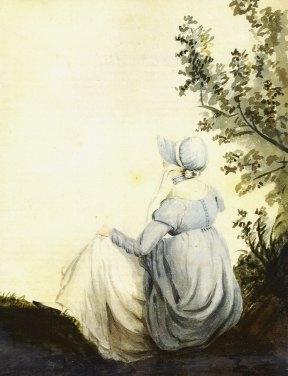
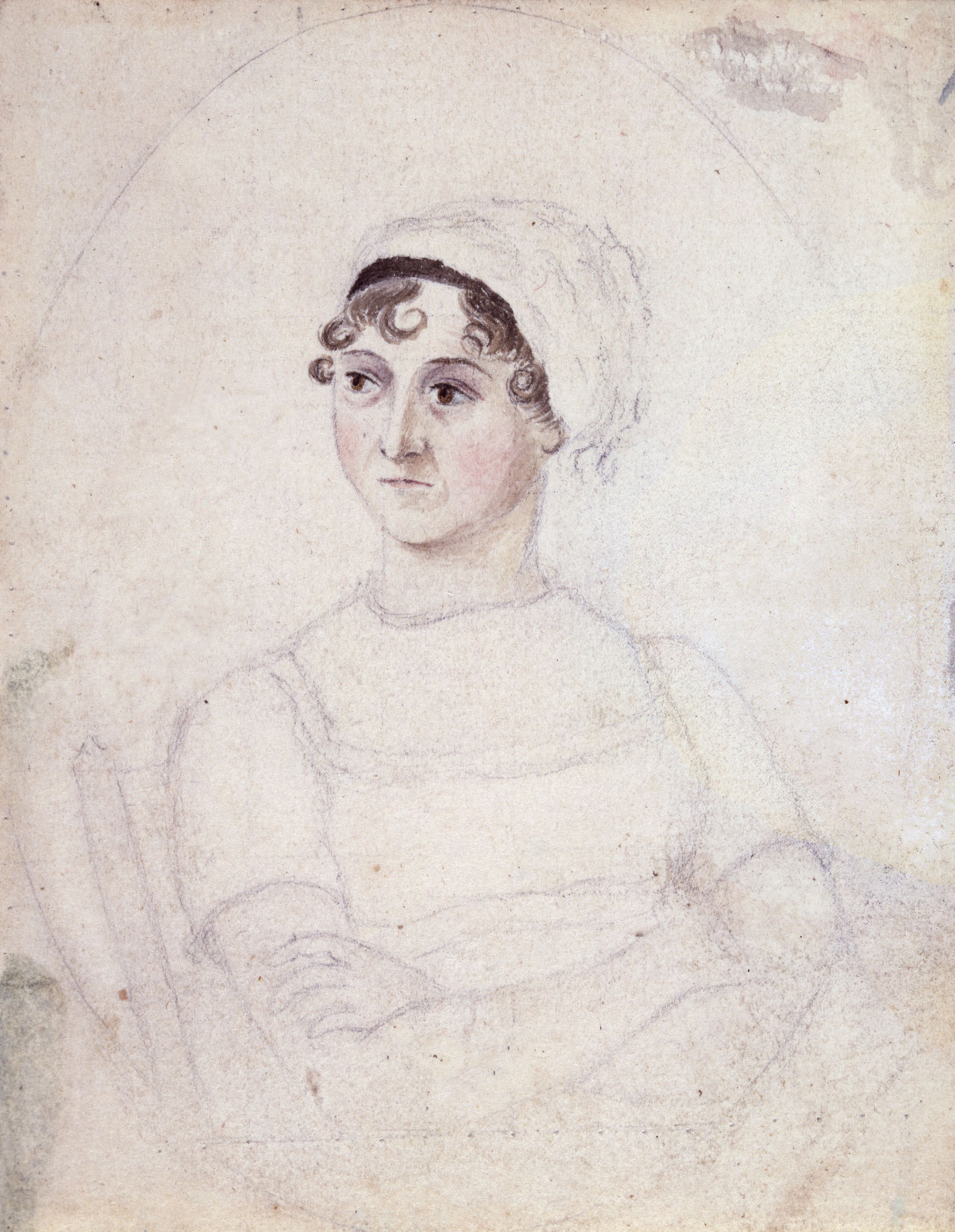
There are only two authenticated pictures of Jane Austen, both drawn by Cassandra. The first sketch is seen in nearly every edition of her books. It was not considered by her family to be a very good likeness. The second is a woman, dressed in blue, sitting outside. She faces away from us. It leaves us to imagine what she is looking at, or thinking. I rather like this image of her.

Saturday, 19 January 2013

Fathers and Sons, by Ivan Turgenev

Anyone who takes a look at my bookshelf can tell you I like a nineteenth century novel. While it is the Victorians who really have my heart I do branch out occasionally. Ivan Turgenev is one of the lesser known Russian authors - outside of Russia that is. During his lifetime he rivalled Tolstoy for popularity, and his signature work is Fathers and Sons. Having enjoyed his novella First Love, I rather expected more from this novel. It is an interesting insight into the divides in mid-nineteenth century Russian society, but in his attempt to create characters that are emblematic of both the nihilistic and the westernised schools of thought, I felt they began to lack actual character. I suspect this problem is exacerbated by the stifling censorship Russian artists found themselves under; this is especially clear at the end of the novel.

As you can probably guess from the title, the book tells the story of two generations of Russians: Nikolai Kirsanov - a wealthy landlord, his son Arkady Kirsanov, and Arkady’s friend Yevgeny Bazarov. Bazarov is a nihilist and has recruited the impressionable Arkady to his cause. At the beginning of the story they have returned to the Kirsanov lands from St Petersburg, and find their philosophy brings them into conflict with Arkady’s father, and uncle Pavel. They both belong to the older generation of Liberals who admire Western values. We also meet in the novel characters who represent traditional Russian views, particularly Bazarov’s parents. These conflicts are tacked onto a mish-mash of lovers, broken hearts, marriages, and even a duel.

At the time of its publication the novel inspired much debate. The conflicting opinions over Russia’s future is apparently historically accurate. The young generation insisted that it did not recognise itself in Turgenev’s depiction. Likewise, the older generation did not like its depiction, although both thought the other well described. It is something of a relief that the generational bashing we see in bollocks newspaper articles (Gen Y is narcissistic, the baby boomers are greedy) is nothing new. At times though I wondered if the real answer is that neither is very well depicted.

It isn’t bad. I’m not saying ‘it is a terrible novel, what have the Russians been thinking for 150 years!’ I just found it uncompelling. This is partly because Turgenev relies too much on telling us things, rather than making them be. Bazarov’s mother is an excellent example of this. For most of the book she bursts into tears every time she thinks of her son, and professes herself almost to frightened to talk to him. Turgenev devotes a few paragraphs to describing this woman, her superstitions, how she doesn’t read books or write many letters, her phobias of mice, frogs, sparrows etc etc. Then suddenly asserts that she is ‘in her own way not at all stupid’. Really? Because you kind of convinced me she was an incredibly stupid woman.

The main problem with this novel, though, is the end. To give a nice neat ending Turgenev resorts to killing off a character. It is done in a particularly ridiculous way. This ending enabled him to get the book published without incurring wrath from the censors. Anything other than an acceptance of the status quo in Russia would have been risky and Turgenev had reason to be wary, having been exiled to his country estates once before. One does wonder what he would have written if he could have. It certainly reads like a missed opportunity.

Saturday, 15 December 2012

Umbrella, by Will Self

I started reading Umbrella by Will Self a few months ago, but only managed 50 pages or so before I had to take to back to the library. Granted, it was a pretty busy time for me, and due to its popularity I only could borrow it for two weeks, but I struggled through those 50 pages. Not quite willing to give up on it though, I requested it again, this time finishing the book. It is an audacious, exhausting and eventually compelling read.

Umbrella follows a few characters over different periods of time. Dr Zack Busner is a psychiatrist working in post-World War II London, and an elderly man in contemporary London. Audrey Death is a working class girl in London’s east end, who becomes a munitions worker in World War I, and eventually one of Dr Busner’s patients. Her brother Stanley Death enlists as a soldier in World War I, and is sent to the front as a gunner. Audrey has languished, in a catatonic state, in psychiatric hospitals for decades before Dr Busner suspects some of the patients are misdiagnosed encephalitis lethargica sufferers and treats with them with new medications - bringing them back to awareness. This is based on real life events familiar to many through Oliver Sacks’s Awakenings.

Self’s novel meanders around this backbone of character and plot. It is a stream of consciousness novel, told in third person and present tense with no chapters. The focus of the novel can shift even mid-sentence, from Audrey to Stanley or so-on. It is at times maddening, one cannot mindlessly drift through the pages. It is a remarkable achievement though that you are always clear whose thoughts you are following. Throughout the text are italicised words or phrases; these seem to represent conscious thought on behalf of the characters, the words they are hearing within their own head. Self’s style is particularly effective in the blurring of Stanley’s own mind between his wartime experience and ‘normal’ life.
We’ll have to reposition! He orders the section at the end of a long burst - and Adeline abandons the cover of the low wall to go forward and reconnoitre. Look at Her! Her skirts dragging through the muck, her proudly hatless head held high….Stanley rises and floats back to the madness of the tea party.
I did think that the sections on Stanley later on in the war were, well odd. They weren’t badly written - in fact they were clever and even amusing in their own right - but I wasn’t sure what they meant. Whether they were real or not. Whether it was even Stanley telling us this story. Against the intense realism of the rest of the novel they just didn’t seem to fit.

At times you could almost imagine Self had just spewed ideas out onto his typewriter. It is a very deliberate novel though: while it seems to be overflowing with ideas, towards the end everything begins to come together. The encephalitic patients have ’tics’ or regular repetitive movements. In Audrey’s case she is repeating the movements she made as a factory worker; in a sense her tics become emblematic of the mechanisation of our world that has occurred since her birth. Family breakdown, women’s lib, the blurring of the class system, it all adds up to a summation of the 21st century. Reading Umbrella can be compared to reading a puzzle: at first it seems like a big pile of thoughts, random and messy, but slowly a shape begins to form and everything finds a place until you are left with a complete picture.

Will Self was widely tipped to win the Booker prize that went to Hilary Mantell’s Bring Up The Bodies. I’m sure he was disappointed not to, as this is a brilliant novel. Had he published it the year before I doubt it would have made the shortlist with the controversial focus on ‘readability’ the Booker panel emphasised that year. I had to make an effort to read it at first, but my persistence paid off.

Sunday, 9 December 2012

The Chrysalids, by John Wyndham

As a teenager I read the usual dystopic novels: The Handmaid’s Tale, 1984, A Brave New World. Somehow I managed to omit John Wyndham from my nerdy reading list. What a mistake. Thanks to my favourite nerdy TV show (ABC‘s First Tuesday Book Club) I picked up The Chrysalids, and I’m glad I did. It is an inventive post-apocalyptic story that had me completely hooked.

The Chrysalids is set a few thousand years in the future, after what is strongly indicated to be a nuclear disaster. It is a coming of age story of David Strorm. David lives on a farm, on something akin to a frontier landscape, society having being reduced to a pre-industrial form. There is a memory of the ’old people’, a technologically advanced society who were all but destroyed by what they know only as ‘Tribulation’. Wyndham creates a strong set of rules that David’s community live by; they practice a fundamentalist form of Christianity, one that is obsessed with the ’true image’. Genetic mutation is common, but also hunted out and destroyed. Nearby are the fringes: land that is wild, where no pure strains can be found. Humans that are found to be mutations are sterilised and abandoned to the fringes. David and a small group of other children are telepaths, something they realise they must conceal if they are to avoid that fate.

David’s father, a prominent man in his community, takes his religion seriously, hunting out genetic mutation in his crops and household with zeal. We learn the fate of some of those not lucky enough to fit the norm; in particular the story of a mother whose newborn has a small mutation is a heartbreaking moment. As it is told through the eyes of a young boy we are spared the gruesome details, nonetheless, the sense of danger Wyndham creates for his protagonist feels very real. Wyndham also hints at a wider world - different communities in other places who also survived ‘Tribulation’. David’s uncle (and confidant) Axel, has travelled as a sailor, and is unable to follow the orthodoxy of their community.
most of them - whether they have seven fingers, or four arms, or hair all over, or six breasts, or whatever it is that‘s wrong with them - think that their type is the true pattern of the Old People, and anything different is a Deviation….You start asking yourself: well, what real evidence have we got about the true image?
Wyndham’s world building is excellent, but it is his characterisations that really make this book interesting. David himself is an atypical lead in that he is often unable to do the right thing, occasionally cowardly, and unprepared when he really shouldn’t be. It is the small characters though, that really make this book. Wyndham imbues minor characters with a sense of humanity, and creates real pathos, such as the aforementioned mother and child. One of the most interesting examples of this are the other telepath children: despite making only the briefest of physical appearances, some have a strong presence.

I’ve agonised a little over the ending, not being completely satisfied as it is dangerously close to deus ex machina. When I began to see it coming I felt bitterly disappointed. Thankfully Wyndham saves the book by not tying up every storyline neatly. While for some characters the ending is happy, the reality that others are left to face is dark and dangerous. Even the ‘happy’ ending leaves us asking some moral questions.

While it is certainly a novel of its time, it also asks questions that are relevant today. While we probably aren’t so concerned about nuclear apocalypse, we do face huge environmental challenges that could have similar impacts. Wyndham also asks us to think about who we will tolerate in our society: where does mutation end and evolution begin? How ‘superior’ are we as beings? Crucially, how do we treat those we deem ‘lesser’ beings to ourselves? Religious fundamentalism is probably even more of an issue in our society than it was when the book was written. People like David’s father are on our news every night.

When so many science fiction classics date badly, Wyndham’s imagined future seems horribly plausible. The book is short and fast paced, and the characters are strong. It is an enjoyable read, that still makes you think about the society we live in, or want to live in.